
I. Intro: Are You Just Guessing, Or Are You Growing?
Every business craves success, an ascent to some imagined peak of market dominance and profitability. But let’s be honest, how many are navigating with a tattered map and a rusty compass, relying more on gut feeling than grounded data? How do you really know if you’re on the right track, or merely running in place?
Enter the unsung heroes of strategic management: Key Performance Indicators. KPIs aren’t just arbitrary numbers; they’re the pulse of your progress, the vital signs that reveal the health and trajectory of your business.
Today, we’ll embark on a journey beyond the surface-level buzz surrounding KPIs. We’ll delve into their essence, trace their historical roots, dissect common implementation pitfalls, and gaze into their AI-powered, data-driven future.
II. So, What Exactly Are These “KPIs” Anyway? (The Basics)
The Lowdown: In the simplest terms, KPIs are measurable values that demonstrate how effectively your company is achieving its key business objectives. They are the quantifiable expressions of your strategic goals.
Why They’re Your Best Friend:
- They cut through the noise. In a world drowning in data, KPIs act as filters, highlighting what truly matters for your specific objectives.
- They’re your crystal ball for data-driven decisions. By tracking KPIs, you move away from guesswork and towards informed, evidence-based choices.
- They keep everyone on the same page, rowing in the same direction. KPIs provide a shared understanding of goals and progress, fostering alignment across teams.
- They spot issues before they become disasters. Regular monitoring of KPIs can flag potential problems early, allowing for proactive intervention.
The “A-Team” of KPIs (What Makes a Good One?): Forget vanity metrics and aim for KPIs that embody the SMART principle: Specific, Measurable, Achievable, Relevant, and Time-bound. Beyond SMART, consider clarity, timeliness, comparability, and verifiability. A KPI shrouded in ambiguity or impossible to track is worse than useless. Remember the Goldilocks principle – strive for focus over volume.
A Peek at the Usual Suspects (Common KPI Categories):
- Money Talks: Profit margins, ROI, cash flow – the financial KPIs that reflect the economic engine of your business.
- Customer Love: Satisfaction scores, retention, churn rates – metrics that gauge the strength of your relationship with your customer base.
- Sales & Marketing Magic: Conversion rates, lead generation, website traffic – indicators that measure the effectiveness of your sales and marketing efforts.
- Operational Excellence: Delivery rates, production volume – KPIs that reflect the efficiency and quality of your operational processes.
- People Power (HR): Employee turnover, time-to-hire – metrics that assess the health and effectiveness of your workforce.
III. A Trip Down Metric Lane: How KPIs Got Their Mojo
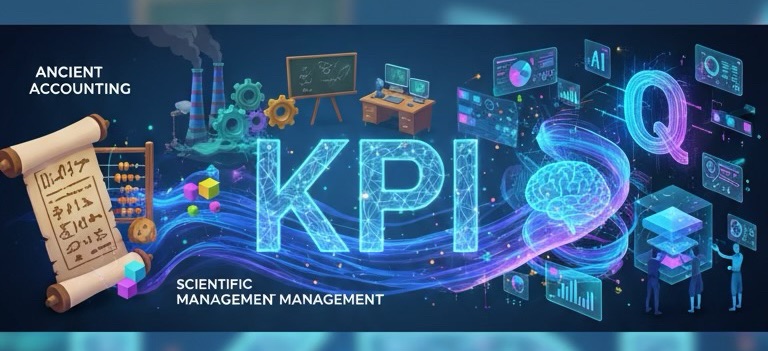
The concept of tracking performance isn’t some modern invention born in a Silicon Valley garage. Its roots run deep, intertwined with the very history of commerce and governance.
Ancient Accounting: Imagine Chinese emperors evaluating the competence of royal family members using rigorous assessments – a form of KPI, albeit with dynastic consequences! Venetian merchants meticulously weighed the potential returns on their investments, a primitive form of ROI calculation.
Industrial Revolution Rises: The advent of the factory floor necessitated a new level of measurement. How efficient were those steam engines? How productive were the assembly line workers? Robert Owen’s colored wooden cubes, used to visually represent worker performance, were a pioneering example of performance tracking.
Scientific Management & Objectives: Frederick Taylor, the father of scientific management, championed the use of data to optimize efficiency. Peter Drucker later formalized the concept of “Management by Objectives” (MBO), placing clearly defined goals at the heart of business strategy.
The “KPI” Name Tag & The Balanced Scorecard Revolution: The actual term “KPI” emerged in the late ’70s/early ’80s, but it was Kaplan and Norton’s Balanced Scorecard in the ’90s that revolutionized how we thought about performance measurement. The Balanced Scorecard broadened the scope beyond purely financial metrics, incorporating customer, internal processes, and learning & growth perspectives.
The Digital Boom: The proliferation of computers, the internet, and mobile devices unleashed a torrent of real-time data. This newfound access to information paved the way for today’s sophisticated tracking systems. The rise of Objectives and Key Results (OKRs) further emphasized the importance of measurable goals and their contribution to the company’s overarching vision.
IV. The Good, The Bad, and The Misunderstood: Current KPI Realities
KPIs, when wielded effectively, are potent tools. But like any instrument, they can be misused, leading to unintended consequences.
Best Practices: Nailing Your Numbers:
- Choosing Wisely: Ensure every KPI is directly linked to a clearly defined business goal. Embrace the SMART principle. Involve key stakeholders in the selection process to foster buy-in.
- The Goldilocks Rule: Avoid metric overload. Experts suggest that 5-8 KPIs are sufficient for SMBs to maintain focus without getting lost in the weeds.
- Leading vs. Lagging: Strike a balance between forward-looking indicators (leading indicators, like website conversion rates) and results-oriented measures (lagging indicators, like customer satisfaction).
- Setting Up for Success: Invest in robust data systems, establish clear communication channels, and integrate KPI monitoring into your daily routines.
The Pitfalls: Where KPIs Can Go Wrong (And Stir Up Trouble):
- “Analysis Paralysis” (Too Many Metrics!): Drowning in a sea of data, unable to discern the signals from the noise. Focus is key.
- “Vanity Metrics”: Numbers that look impressive but don’t translate into meaningful business outcomes (e.g., millions of website visitors, but zero conversions).
- Gaming the System: When employees or teams prioritize hitting a KPI above all else, potentially sacrificing quality, innovation, or other unmeasured aspects.
- Static Thinking: KPIs aren’t set-it-and-forget-it! Business goals evolve, so your KPIs must adapt accordingly. Regular reviews are essential.
- Data Dilemmas: Garbage in, garbage out. Inaccurate or inconsistent data undermines the entire KPI framework. Data integrity is paramount.
V. Into the Future: Where KPIs Are Heading (Hint: It’s Smart!)
The future of KPIs is inextricably linked to the relentless march of technological progress. Artificial intelligence, big data, and real-time analytics are poised to revolutionize how we measure and manage performance.
AI & Big Data: The Ultimate Power Couple:
- Prediction Masters: AI algorithms can analyze vast datasets to predict future trends and potential risks, transforming KPIs from descriptive to predictive tools.
- Automated Insights: AI-powered systems can automatically identify patterns and anomalies in KPI data, generating actionable insights without human intervention.
- New Metrics on the Horizon: AI is uncovering entirely new ways to measure performance and identify previously hidden opportunities.
Real-time Everything: Edge computing and IoT integration will enable near-instantaneous feedback loops, allowing for faster and more agile decision-making.
Agentic AI: Imagine AI systems that autonomously set goals, plan tasks, and adapt to changing circumstances, managing KPIs without constant human supervision.
Democratizing Data: Tools like AutoML are making advanced analytics accessible to a wider audience, empowering non-technical users to leverage the power of data.
Quantum Leaps: In the more distant future, quantum computing could unlock unprecedented capabilities in KPI analysis, enabling us to process truly massive datasets and uncover insights that are currently beyond our reach.
VI. Conclusion: Don’t Just Measure, Master!
KPIs are far more than just numbers on a spreadsheet. They are the strategic compass that guides your business, shaped by historical lessons and supercharged by modern technology.
The key takeaway is this: Implementing, tracking, and, most importantly, acting on the right KPIs is crucial for navigating the complexities of today’s business environment and thriving in the future.
So, what are your key performance indicators? Start defining them intelligently, using them wisely, and prepare for a future of data-driven, intelligent growth!
Get Your Copy Today!
Ready to transform your team’s performance and take your business to new heights? Click here to purchase KPI Main Key Performance Indicators: Guide for Beginners on Amazon now.
 KPI - Key Performance Indicators
Leave a comment